


Choosing a worktop involves more than simply picking a colour and hoping for the best. Natural stone and engineered surfaces are full of movement, veins and patterns, which means how the slabs are arranged can completely change the final look.
Done well, slab matching can create flowing patterns, dramatic centrepieces or beautifully balanced designs. Done badly… well, let’s just say it can look like two completely different worktops met each other halfway through installation.
Fortunately, there are several tried-and-tested matching techniques that fabricators use to make the most of a material’s natural beauty. And with modern technology, the process is far more precise than it once was.
Below is a guide to the main types of slab matching, the materials that work particularly well for each, and how Rock Revelations uses advanced scanning technology to plan it all before a single cut is made.
Why slab matching matters
Stone slabs are a bit like snowflakes – no two are exactly the same. Even engineered surfaces designed to replicate marble include variation in veining so they feel more natural.
That variation is part of what makes stone so beautiful, but it also means planning matters. Slab matching helps ensure that the veins don’t suddenly change direction halfway along your worktop or form a join that looks like an awkward design decision.
With careful planning, slab matching can:
- Create a smooth visual flow across worktops
- Turn islands or splashbacks into statement pieces
- Make seams far less noticeable
- Ensure the best parts of the slab are used in the most visible areas
In short, it’s the difference between a worktop that looks considered and one that looks… accidental.
Book matching
Book matching is the showstopper of the stone world.
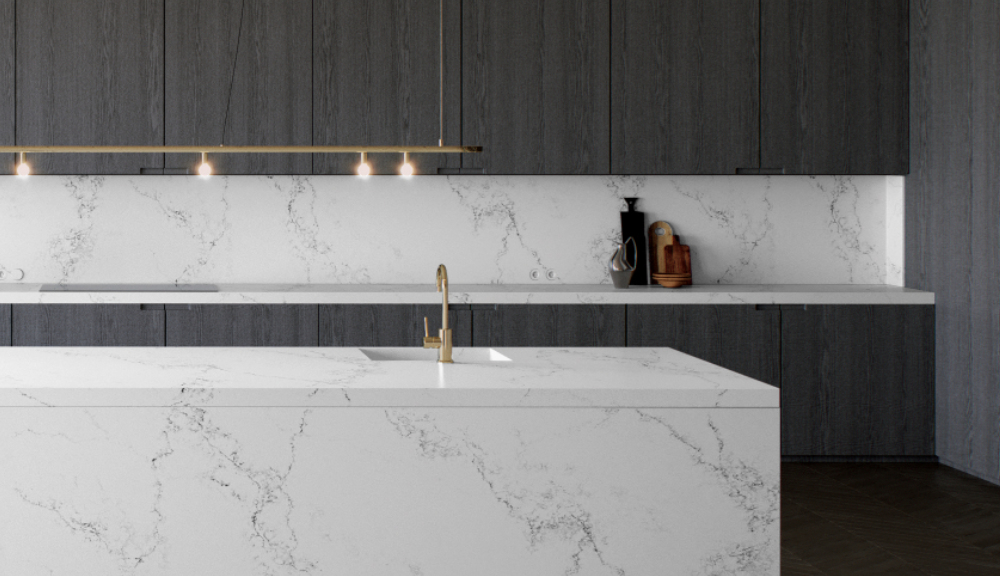
Two consecutive slabs are opened like the pages of a book so that the veining mirrors across the centre join. The result is a perfectly symmetrical pattern that often resembles butterfly wings, waves or abstract artwork.
It’s bold, dramatic and ideal for spaces where the stone itself is meant to be the main feature – kitchen islands, splashbacks and large wall panels are popular choices.
Materials that work well
Book matching works best with materials that have strong, expressive veining.
Examples include:
- Caesarstone marble-effect quartz
- Silestone quartz surfaces
- Compac quartz designs
- Neolith sintered stone
- Dekton surfaces
These materials often feature large marble-style veins that look particularly striking when mirrored across a seam. When done properly, the result can feel less like a worktop and more like a piece of natural art.
Vein matching
If book matching is the dramatic one in the room, vein matching is its calmer, more subtle cousin.
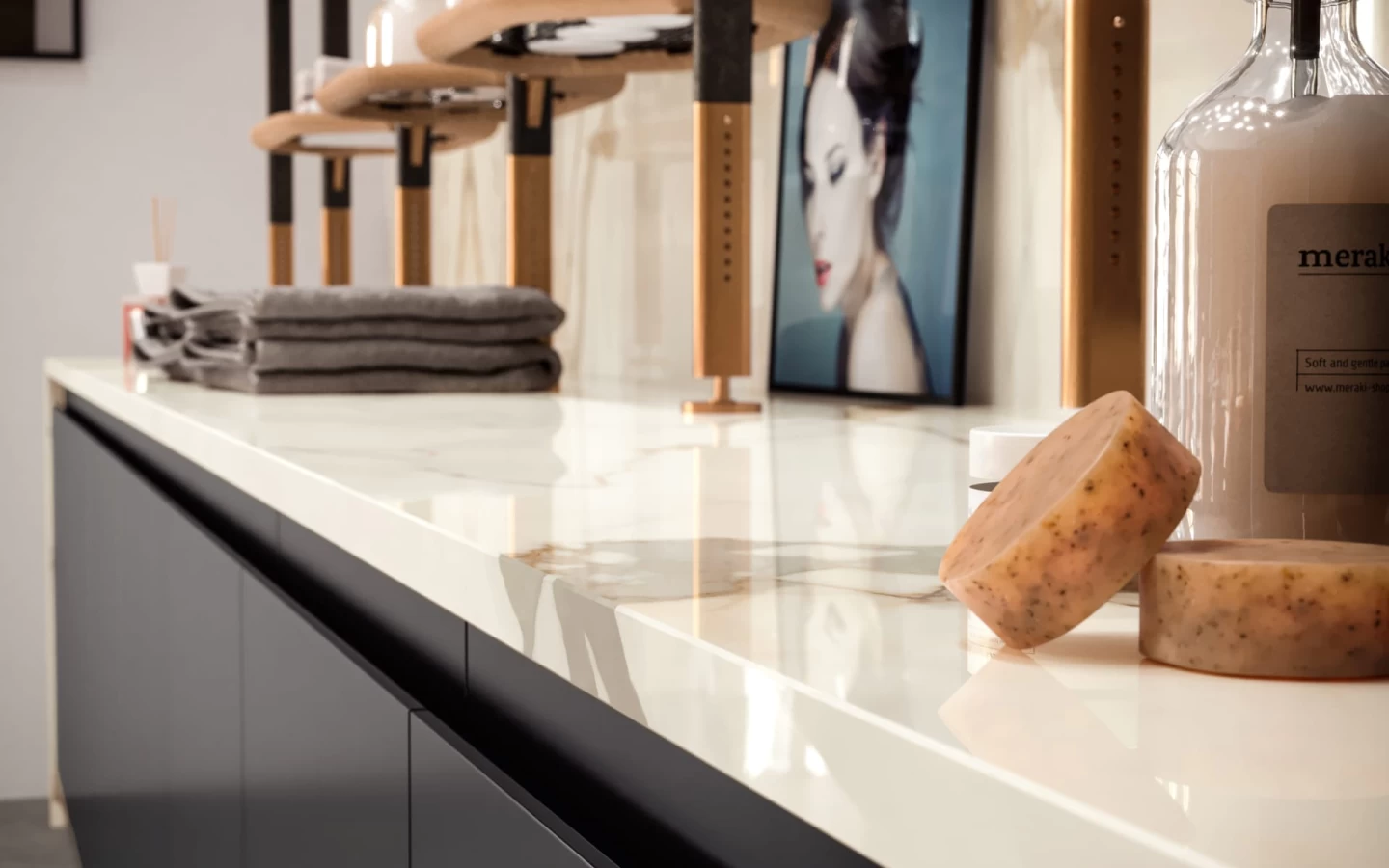
Rather than mirroring the pattern, vein matching focuses on continuing the natural flow of the veins across joins. The aim is to make the surface look like one continuous slab rather than several pieces joined together.
It’s commonly used on long kitchen runs or L-shaped worktops where keeping the pattern flowing naturally makes the whole design feel more cohesive.
Materials that work well
Materials with long directional veins tend to work best.
Examples include:
- Quartzforms quartz
- CRL Quartz surfaces
- Dekton sintered stone
- Atlas Plan porcelain slabs
These materials often feature linear veining that can be carefully aligned so the pattern appears to travel across the entire surface.
End matching
End matching is exactly what it sounds like. Instead of mirroring or flowing sideways, the pattern continues directly from the end of one slab into the next.
This is particularly useful when a kitchen design requires multiple slabs across a long stretch of worktop. Done correctly, the pattern appears to carry on naturally rather than abruptly stopping at each join.
Think of it as extending the story of the stone across the room.
Materials that work well
Materials with consistent pattern movement tend to produce the best results.
These include:
- Granite
- Marble
- Dekton
- Neolith
- Atlas Plan porcelain
Because these materials often have strong yet consistent veining, fabricators can position slabs so the pattern continues smoothly.
Random matching
Random matching takes a more relaxed approach. Rather than carefully aligning patterns, slabs are positioned without trying to match the veining. This allows the natural variation of the material to speak for itself.
It works particularly well with surfaces that have subtle patterning, where joins are less noticeable regardless of alignment. In other words, it’s the design equivalent of letting the stone do its thing’.
Materials that work well
Materials with softer or more uniform patterns are ideal.
Examples include:
- Cimstone quartz
- CRL Quartz
- Unistone quartz
- Speckled granite
These surfaces often have smaller patterns or consistent textures, meaning they still look cohesive even without deliberate matching.
How Rock Revelations achieves precise slab matching
While slab matching might look effortless once installed, a surprising amount of planning happens behind the scenes.
Before fabrication begins, the team at Rock Revelations carefully assesses each slab to determine how the pattern should be positioned within the final design. The aim is always to highlight the most attractive areas of the material while ensuring joins are placed thoughtfully.
Technology plays a big role in making this process more accurate.
The Iris slab scanner
Rock Revelations uses a high-resolution 12K d2 Iris slab scanner in its fabrication centre to digitally map every slab before cutting. This scanner captures a detailed image of the entire slab surface, allowing the fabricators to analyse the veining and plan exactly how the pieces will be cut and arranged.
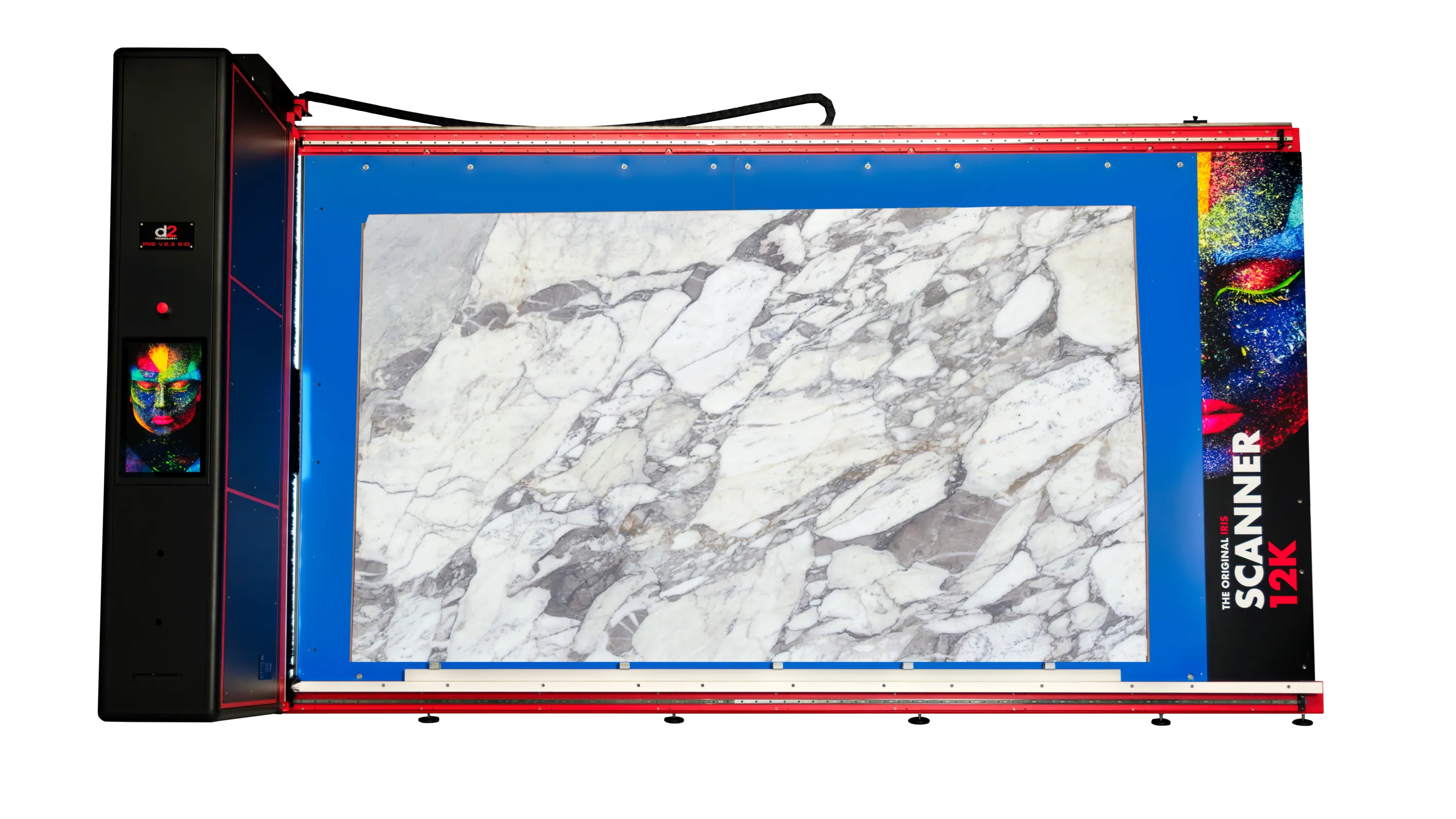
With this technology, the team can:
- Visualise the full slab pattern before fabrication
- Plan book matching or vein matching layouts
- Position seams more carefully
- Maximise the usable material
In practical terms, it means the design can be mapped digitally before anything touches a cutting blade, which is very good news when you’re working with large and beautiful slabs of stone.
Craftsmanship supported by technology
While modern scanning and CNC machinery provide incredible accuracy, slab matching still relies on the experience of skilled fabricators.
At Rock Revelations, traditional stonemasonry expertise works alongside digital slab scanning and precision cutting equipment. The combination ensures each worktop is not only technically accurate but also visually balanced.
Because at the end of the day, stone fabrication is equal parts science and artistry. It’s how man and machine work together to bring out the best in a material.